
The New York Lawsuit That Could End Loot Boxes in America by 2026
Valve's CS2 loot boxes face a reckoning as New York's gambling lawsuit could end paid mechanics if virtual skins are deemed 'something of value'.
As I sat in the dim glow of my triple-monitor setup, the familiar clatter of a Counter-Strike 2 case opening filled my headphones. For a split second, I held my breath—would it be a rare knife skin, or yet another consumer-grade disappointment? That rush, that tiny gamble, has been part of my professional life for years. But in 2026, that feeling might be living on borrowed time. I'm talking about the seismic legal battle that erupted when New York Attorney General Letitia James dragged Valve Corporation to court, accusing them of promoting illegal gambling through loot boxes. And honestly? If she wins, it could wipe paid loot boxes off the map for all of us, coast to coast.
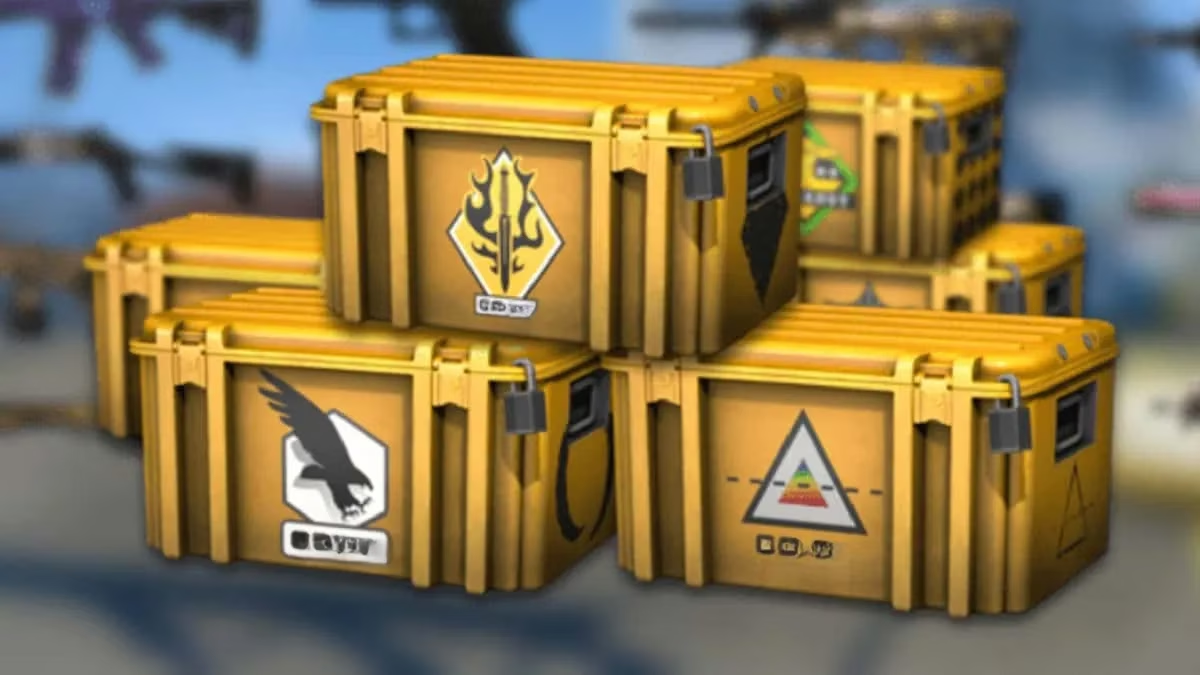
When gaming lawyer Harris Peskin called the lawsuit “absolutely MASSIVE news for the gaming and esports ecosystem,” he wasn't exaggerating. I remember watching his analysis on a stream, my Discord server exploding with questions. What exactly was at stake? Peskin explained the core legal question that could reshape my entire industry: when I open a case and get a skin, am I really “receiving something of value”? Under New York law, gambling requires three things—staking something of value, on a future event beyond your control, with the understanding you'll get something of value back. The first two parts are obvious: I pay for a key or case, and I can't control what drops. But that third part? That’s where the courtroom fireworks ignite.
This isn't some abstract legal theory. Think back to the 2018 Kater vs. Churchill Downs case. A court there decided that virtual chips—even ones you could never redeem for cash—still counted as a “thing of value.” Peskin highlighted this, and my mind immediately jumped to the thousands of dollars in skins rotting in my Steam inventory. Sure, Valve’s terms of service say skins have no real-world value, but we all know the truth. Third-party marketplaces thrive, and some of my teammates have sold rare skins for enough money to pay rent. The argument that these are just digital trinkets is starting to look like a house of cards.
Have you ever stopped to wonder why we accept this? I've asked myself that a lot lately. Every time I click “open case,” I'm engaging in a mechanism that’s virtually identical to pulling a slot machine lever. The New York AG’s case leans heavily on Section 225 of the state penal code, and if a judge agrees that loot box rewards meet that “thing of value” threshold, the ramifications truly are, as Peskin put it, “HUGE.” We're not just talking about Counter-Strike 2 and Team Fortress 2. The logic cuts through the entire industry like a hot knife through butter.
Imagine a world where no game publisher can sell a single mystery box in New York without facing gambling charges. Given that New York is one of the largest markets in the United States, do you think EA, Activision, or Riot Games would design entirely separate monetization systems for one state? Absolutely not. The financial shockwave would be immediate. Peskin argued that “virtually all lootboxes of any type” could become impermissible in New York, and then “other states with similar statutes would seek relief.” California, Washington, Illinois—each one could follow suit overnight. For me, that means the digital slot machines I've spent a small fortune on might finally be switched off, not by a developer’s goodwill, but by the long arm of the law.
I glanced at my League of Legends client yesterday, staring at the Hextech crafting system. You buy Masterwork Chests, open them, and get random shards and cosmetics. Is that illegal gambling now too? Peskin threw that exact question into the conversation, and it sent a chill down my spine. If a skin from a CS2 case is a thing of value, then a Prestige skin from a League chest certainly is. The whole free-to-play economy, built on selling randomized rewards, could come crashing down. In 2026, we’ve already seen hints of what a post-loot box world looks like. Remember Valve’s European experiment? Back in 2019, after France cracked down on gambling in video games, CS:GO players there got an X-ray scanner that showed case contents before purchase. Belgium and the Netherlands saw similar restrictions. I played on those servers once—the excitement was gone, but so was the predatory mystery. Could America finally catch up?
Of course, Valve isn't going down without a fight. Their defense will “almost certainly point to its Terms of Service and its conduct against third-party marketplaces,” Peskin noted. They’ll argue they actively try to shut down the liquid value skins have by banning trade bots and gambling sites. In their eyes, they’re not facilitating gambling; they’re fighting it. I'm torn on this. I've seen Valve’s anti-gambling statements, but I've also seen them profit directly from case keys and the Steam Community Market, where they take a cut of every transaction. The line between denying real-world value and enabling it feels deliberately blurry.
Sitting here in 2026, as the legal proceedings inch forward, I feel a strange mix of hope and anxiety. Part of me yearns for a cleaner gaming landscape where I'm not constantly tempted to drop $20 on a glorified dice roll. Another part of me worries about what replaces loot boxes. Will publishers pivot to even more aggressive battle passes, direct purchases with exorbitant prices, or some new manipulation we haven't even imagined yet? The end of loot boxes wouldn't kill gaming, but it would force a radical evolution. For now, every case I open feels heavier than before. Each brilliant blue or purple glow isn't just a skin—it’s a little piece of a multibillion-dollar question mark. And if New York has its way, that question mark might soon turn into a full stop for the entire country.