
How PUBG Mobile Transformed Its Esports Scene – A Player’s Look Back at the 2025 Circuit and What’s Next
PUBG Mobile esports 2025 roadmap's $10M grassroots investment and Ultimate Royale pipeline reshaped amateur play worldwide.
I still remember the buzz around the PUBG Mobile Global Championship at the end of 2024. The atmosphere inside the arena was electric, but what really stuck with me wasn’t just the action on stage – it was the roadmap that Level Infinite revealed for the year ahead. As a regular player who follows the competitive scene closely, I felt a genuine shift was coming. Now, looking back from 2026, I can say that the promises made back then weren’t just words. They reshaped how we experience PUBG Mobile esports from the ground up.
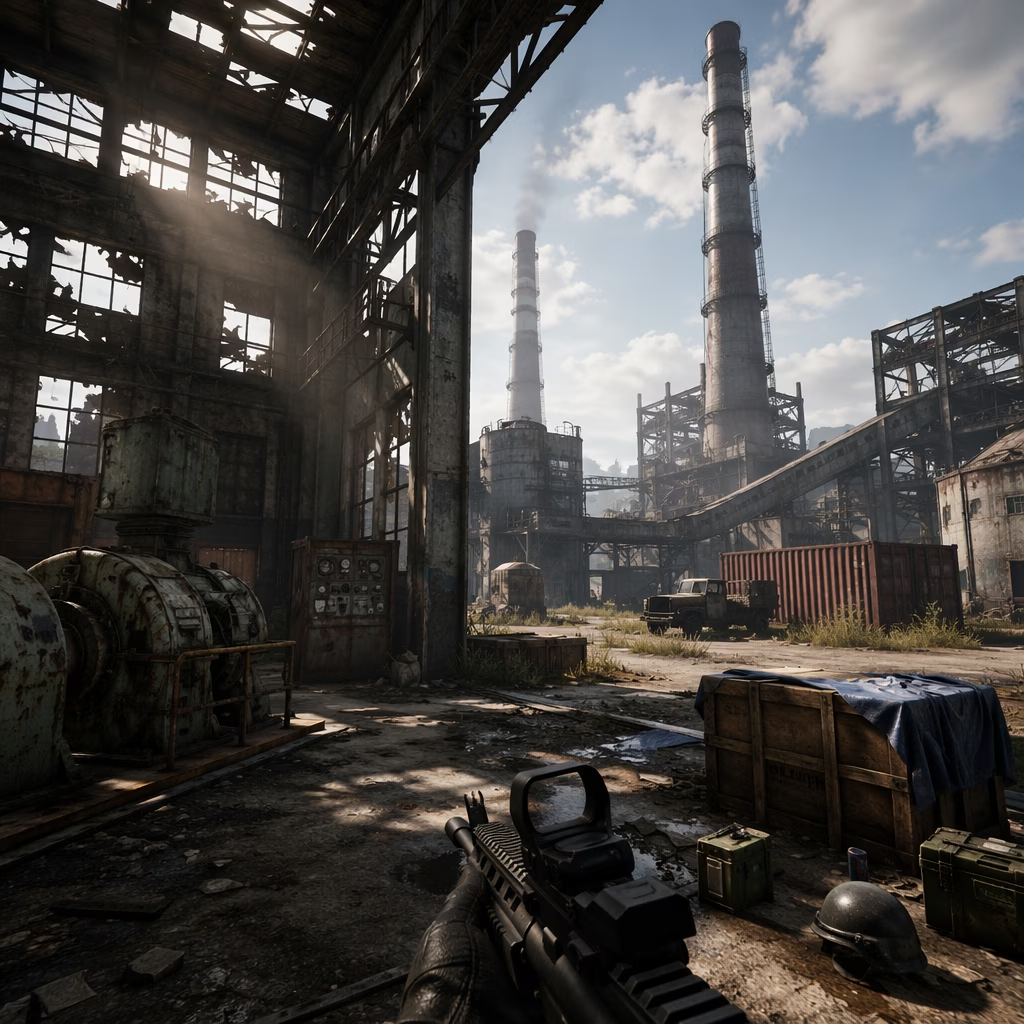
The biggest headline was the $10 million investment into grassroots opportunities. Before 2025, many of us felt that the competitive ladder was too steep for amateur squads. Huge prize pools existed, but mainly at the highest levels, while smaller local scenes struggled for attention. Other mobile titles were eating into that space, and I often found myself wondering if my friends and I would ever get a real shot. That changed dramatically. The investment went directly into third-party tournament incentives, prize pools for regional clashes, and dedicated female-focused events. Those early qualifiers I joined in Southeast Asia suddenly felt professional, with better production, more consistent schedules, and a real path upward.
A key driver was the Ultimate Royale ranked mode, which had already gained traction among serious players. By using this in-game ladder as a direct pipeline to pro play, the developers unlocked something special. The top 500 ranked players could bypass the first round of the 2025 PUBG Mobile Global Open (PMGO) qualifiers. For the first time, local heroes didn’t need insider connections or an established organization behind them. I personally rose through those ranks with a tight-knit team, and the thrill of seeing our names in the qualifier bracket was unforgettable.
Over twenty regional tournaments were spun up across Southeast Asia, Europe, the Middle East and Africa, Central and South Asia, and the Americas. Each region fed into the higher tiers: the PUBG Mobile Super League (PMSL), PMGO, and the PUBG Mobile World Cup (PMWC). The PMGO itself landed in Uzbekistan for its 2025 edition, and the choice of location proved to be a masterstroke. It brought the event closer to emerging fanbases and rewarded local talent who might never have traveled to Western venues. Watching the grand finals from Tashkent, I felt that the global nature of PUBG Mobile esports was finally matching the game’s truly worldwide player base.
The centerpiece of the year remained the PUBG Mobile Global Championship. In 2025, Thailand hosted the grand finale across several weeks. The production value was through the roof, and the crowd’s energy reminded me why I fell in love with this esport. Looking back from 2026, that PMGC will be remembered as the moment when the grassroots pipeline delivered. Several previously unknown rosters stood on that stage, proving that the investment had paid off. The storyline of underdogs climbing through Ultimate Royale, mastering regional tournaments, and then competing in a packed Bangkok arena is exactly what a healthy ecosystem needs.
What truly widened the scope, however, was the expansion into non-classic modes. For years, competitive PUBG Mobile was almost entirely about battle royale. In 2025, the esports plan brought World of Wonder creative maps, Metro Royale survival challenges, and Team Deathmatch into the fold. I’ll admit I was skeptical at first, but the variety made a huge difference for viewer engagement. As someone who also enjoys creating maps, the Esports Creation Program allowed me to submit ideas that were used in official showmatches. The program further supported PDP Design, caster bootcamps, and storytelling projects – turning fans into contributors and polishing the narrative fabric around every tournament.
Female-focused events also took a major leap forward. Previously, they were often side attractions with minimal prize pools, but the 2025 blueprint gave them standalone circuits and media coverage. I watched several all-women squads not only dominate their own series but also qualify for mixed open events, and seeing their growth was one of the highlights of the year. It made the community feel more inclusive and opened up new role models for players worldwide.
Looking at 2026, the foundation laid during the 2025 circuit is still evolving. The Ultimate Royale to PMGO pipeline has been refined with better anti-cheat measures and shorter seasons to prevent burnout. Regional prize distribution is more transparent, with live dashboards showing exactly where the $10 million was allocated in real-time. The Esports Creation Program has now spawned a full academy that trains casters and analysts, feeding talent directly into the broadcast studios of PMSL and PMGC.
Here’s a quick snapshot of how the structure matured from 2025 into 2026:
| Component | 2025 Implementation | 2026 Evolution |
|---|---|---|
| Grassroots Investment | $10M injected into prize pools, third-party events, female circuits | Sustainable creator fund, automatic revenue share for regional organizers |
| Qualification Path | Top 500 Ultimate Royale skip PMGO first round | Dynamic cutoffs, monthly qualifier cycles, dedicated path for Metro Royale |
| Global Events | PMGO in Uzbekistan, PMGC in Thailand | Rotating host cities, fan voting for wildcard slots |
| Mode Diversity | World of Wonder, Metro Royale, TDM introduced | Ranked Metro Royale integrated into esports, map-making contests with live finals |
| Inclusion | Female-focused separate tournaments | Integrated mixed qualifiers, mandatory 50% representation targets in official broadcasts |
From my perspective as a player who jumped into the 2025 qualifiers and still grinds today, the transformation is real. The feeling that anyone can make it – that your squad’s midnight practice sessions actually lead somewhere – is no longer a marketing slogan. The path is clearer, the support is stronger, and the community is richer. PUBG Mobile esports in 2026 feels like a living, breathing ecosystem rather than a top-heavy spectacle. And honestly, I couldn’t be more excited to see where the next drop lands.